This guide covers the 11 positions youth players meet and is written for volunteer coaches and parents. Each position tells you where the player stands and what to say from the sideline. Later sections explain the full back job, how positions change with team size, and why every child should try several jobs. If you are new to coaching, read the cues for the two or three positions on your team and use them at your next practice.
Soccer positions at a glance
Think of a team as three lines in front of the goalkeeper. The back line protects the goal, the middle line links the team, and the front line scores.
A child can learn one line at a time. Start with the line where they feel most comfortable, then move them one line forward or back after a few games.
The positions, one by one
Each position has one sentence for the ball and one for no ball. The cues are short enough to shout from the sideline.
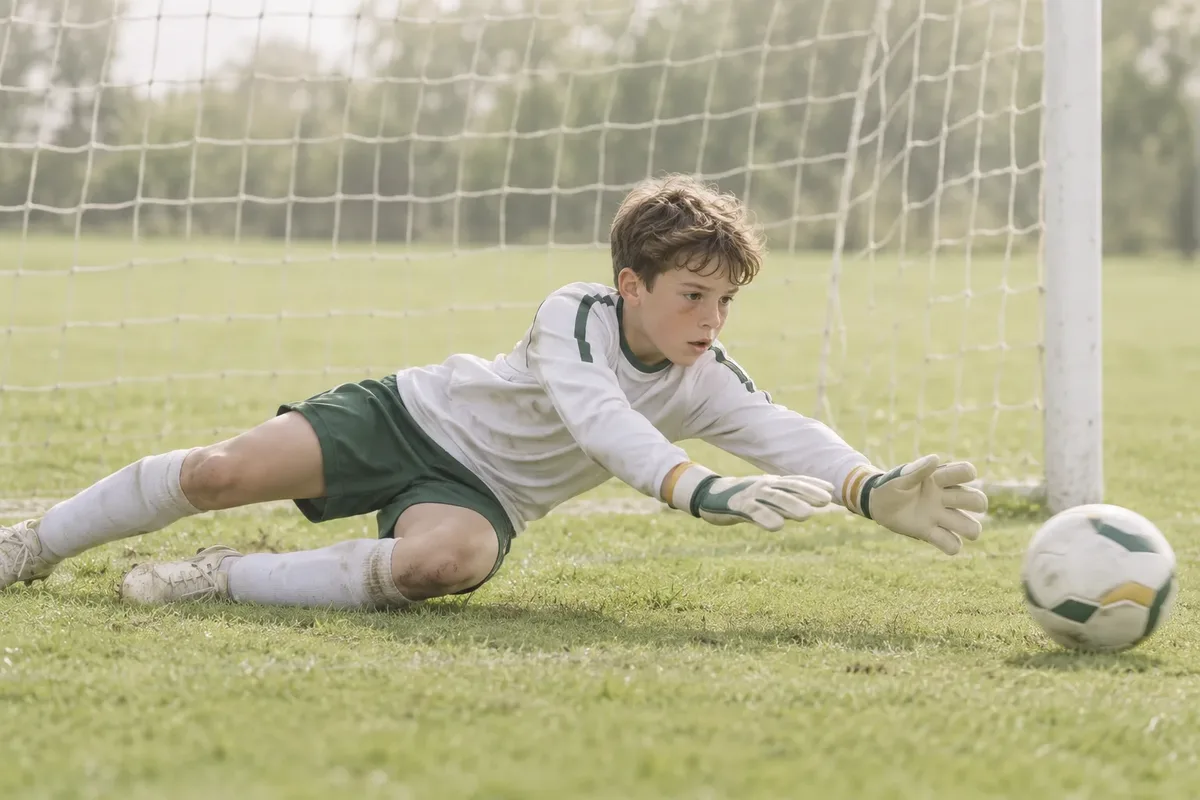
Goalkeeper
With the ball, they roll or throw it to a nearby teammate. Without the ball, they stand ready between the ball and the goal.
GoalkeeperSuits a child who… likes to use their hands; stays calm under pressure; talks to teammates.
- Knees bent, hands out.
- Call 'keeper' when you want the ball.
- Roll it out, then find space.
Common mistake
Standing on the goal line. Ask them to take a few steps out so they can see the whole field.
Center back
With the ball, they pass to a midfielder or a fullback and step forward with the team. Without the ball, they stay between the ball and the goal.
DefenderSuits a child who… likes to protect space; notices danger early; enjoys clear communication.
- Keep your head up so you can see the whole field.
- Talk to your partner: who goes, who covers?
- Pass first, kick long last.
Common mistake
Both center backs chase the ball at once. Tell one to challenge and the other to stand a few steps behind as cover.
Right back
With the ball, they pass inside or run forward along the sideline. Without the ball, they stop the player on their side from going past them.
DefenderSuits a child who… likes running up and back; spots wide space; recovers quickly.
- Look for your winger before you move forward.
- Show your teammate where you are before you receive the ball.
- When the ball is on the far side, move in.
Common mistake
Running forward and leaving the whole right side open. Ask them to go forward only when a teammate is covering behind them.
Left back
With the ball, they pass inside or run forward along the sideline. Without the ball, they slide toward the middle when the ball is on the other wing.
DefenderSuits a child who… likes running up and back; spots wide space; recovers quickly.
- Look for your winger before you move forward.
- Show your teammate where you are before you receive the ball.
- When the ball is on the far side, move in.
Common mistake
Staying wide when the ball is on the other side. Remind them that the middle of the field needs help first.
Defensive midfielder
With the ball, they take a pass from the back line and move it to a teammate. Without the ball, they close the space in front of the defenders.
MidfielderSuits a child who… likes reading the game; looks before receiving; helps teammates stay connected.
- Show for the ball, then pass it forward.
- Receive, look up, pass.
- When we lose it, get back to the top of your penalty area, just in front of your center backs.
Common mistake
Drifting forward after the ball. Give them that spot as their home base to return to.
Central midfielder
With the ball, they find a teammate who is open and pass. Without the ball, they move to help whichever teammate is closest to the ball.
MidfielderSuits a child who… likes joining both ends; keeps moving to support; shares the ball.
- Be the easy pass: show for the ball.
- Look around before the ball arrives.
- Run to help, then run back.
Common mistake
Standing still after passing. Tell them to pass and move, so the next pass has a place to go.
Attacking midfielder
With the ball, they look for the pass that sends a teammate toward the goal or shoot from close range. Without the ball, they stay close to the striker so the team can win the ball back.
MidfielderSuits a child who… likes finding open pockets; turns to face goal; creates chances.
- Find space between their midfield and defense.
- Receive facing the goal.
- When we lose it, press the nearest player.
Common mistake
Standing too close to the striker. Ask them to drop a few steps so the striker has room.
Wide midfielder
With the ball, they dribble down the side or pass to a striker. Without the ball, they come back to help the fullback on their side.
MidfielderSuits a child who… likes wide running; tracks back; crosses or cuts inside.
- Stay wide when we have the ball; tuck in when we don't.
- Dribble up the sideline, then look for the cross.
- Look up at the end line, then pass across the goal.
Common mistake
Cutting into the middle too early. Ask them to keep one foot near the sideline until a teammate arrives.
Winger
With the ball, they run at a defender or pass to a teammate in the middle. Without the ball, they stay wide so the other team's defense spreads out.
ForwardSuits a child who… likes wide running; tracks back; crosses or cuts inside.
- Get your head up before you run.
- Dribble when you have space; pass when a second defender comes.
- When we lose it, run back to the halfway line.
Common mistake
Waiting by the sideline for the ball to arrive. Ask them to move toward the ball and then away from it.
Striker
With the ball, they shoot or pass to a teammate who has a better chance. Without the ball, they move away from defenders into open space.
ForwardSuits a child who… likes leading the press; finds space near goal; helps connect passes.
- Shoot when you see the goal.
- Show for the ball, then spin away.
- Hold the ball up when your teammates are far behind you.
Common mistake
Waiting beside the goal. Tell them to show for the ball first and then spin away, because that move creates the space.
Second striker
With the ball, they pass to the striker or run past them into space. Without the ball, they stay close enough to help win the ball back.
ForwardSuits a child who… likes linking play; moves into open space; supports the striker.
- Stay one pass from your striker.
- When the striker drops, you go forward.
- Shoot after your pass if you get it back.
Common mistake
Standing at the same height as the striker. Ask them to stand a little deeper, so the pair makes a diagonal.
Full back in soccer: three moments
A fullback (also written full back or full-back) is a defender who plays on the sideline side of the back line. Left and right are set by the direction your team attacks. The job changes with three moments of the game.
The fullback is not a winger. A winger is a forward who starts near the sideline and mostly attacks. The fullback starts behind the ball and defends first.
A wing-back is a fullback with a bigger attacking job. Wing-backs usually play in teams with three center backs, so the whole sideline belongs to them. Most youth teams play with fullbacks, so use the fullback cues unless your coach has set up three center backs.
Sideline cues: "Pass inside first." "Go when someone covers." "Ball far side, you come in."
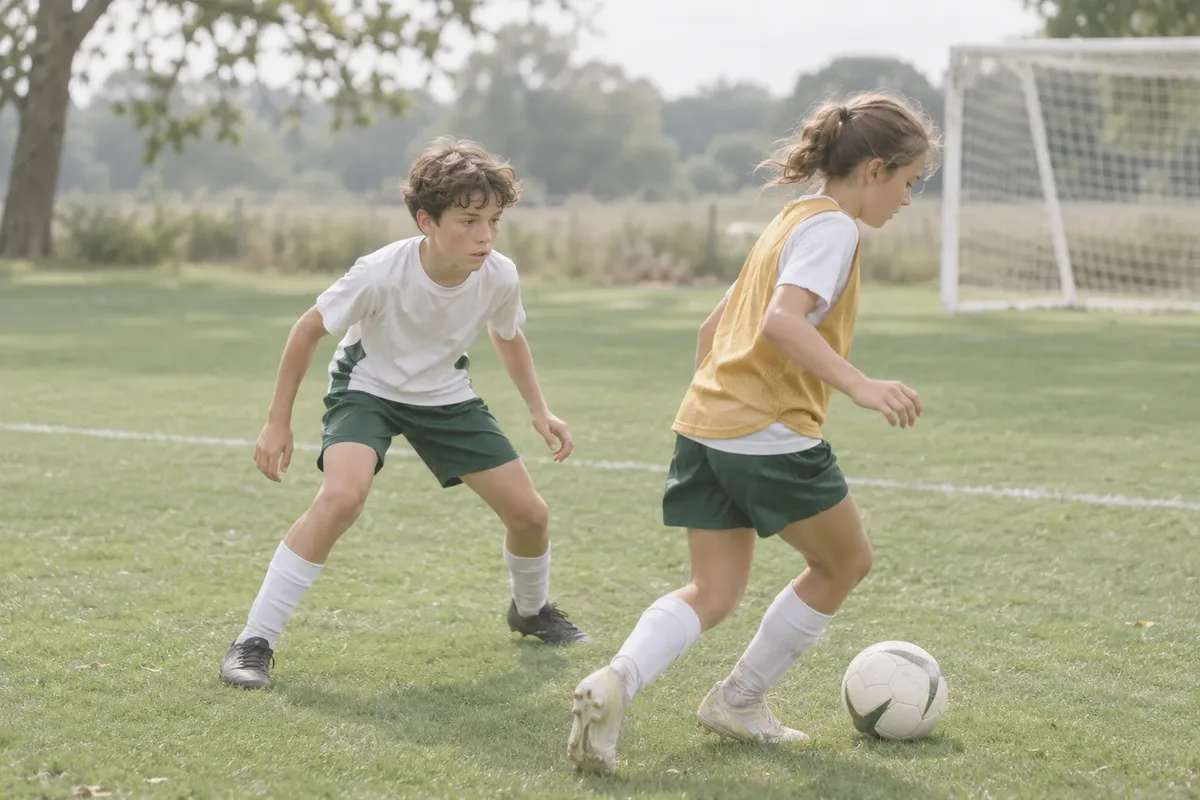
Position terms in plain words
| Pair | The difference |
|---|---|
| Position and role | A position is where the player stands, such as right back. A role is the job there, such as "stay home" or "overlap". One position can have different roles. |
| Position and shirt number | The position is the job. The number is on the shirt and often follows the player, not the job. Today the 4 is usually a center back and the 6 a defensive midfielder, though some older sources swap them. The full list is on Soccer position numbers. |
| Fullback and wing-back | A fullback defends first and goes forward when covered. A wing-back plays the whole sideline and attacks more, usually with three center backs. U.S. Soccer's 7v7 example uses the name for its two wide defenders. |
| Winger and wide midfielder | A winger is a forward who starts wide. A wide midfielder sits on the middle line and helps the fullback. |
| Sweeper (libero) | A defender who plays behind the main back line to cover space. Most youth teams do not need a fixed sweeper. |
| Box-to-box midfielder | A midfielder who supports attacks and recovers to defend across the length of the field. |
How positions change with team size
Smaller teams have fewer jobs, so each child learns one or two roles at a time. U.S. Soccer sets a maximum format by age (U.S. Soccer game formats): 4v4 at U7 to U8, 7v7 at U9 to U10, 9v9 at U11 to U12, and 11v11 from U13. Smaller formats can be played at every age.
In 4v4 nobody has a fixed job, and U.S. Soccer says all players attack and defend. From 7v7 there is a goalkeeper, a back line, a middle and a striker. Winger and second striker appear when a team has three or two forwards, and the attacking midfielder appears when the middle is crowded enough to need one.
Shapes and starting lines for each size are on Formation guide: 7v7 and Formation guide: 9v9.
Try a game, then decide
Use this routine when a child asks "what is my position?" or a parent asks why the child moved.
Keep the child's favorite spot in the rotation.
Why youth players should rotate positions
Spot the wrong position
The position quiz sits under the board above. This second tool is a game: three rounds on a team of seven players. Tap the player who is out of position, then read why.
Both tools run in your browser. They do not store your name or answers. The quiz result link holds only position codes, and you can copy it or try again.
How the position quiz works
Each of the 8 questions asks what you like to do in a game. Every answer adds points to the positions it suits. The two positions with the most points are shown. A third is shown only when it ties for second with at least 5 points, and the goalkeeper is added when it scores at least 5.
The quiz does not look at speed, size or skill, or at what your team needs. Treat the result as a starting point for your next practice, not a decision about where a child plays.
FAQ
What are the different soccer positions and their roles?
A soccer team has one goalkeeper, defenders, midfielders and forwards. This guide covers 11 position names, from goalkeeper to second striker, and gives each one a job with the ball and a job without it. Smaller teams share and split these jobs.
How do youth soccer positions differ from adult soccer positions?
Youth teams play smaller games, so there are fewer positions. U.S. Soccer sets a maximum format by age: 4v4, 7v7, 9v9, then 11v11 from U13. In 4v4 nobody has a fixed job. Positions such as the defensive and attacking midfielder appear when the team is large enough to need them. See how positions change with team size.
What are the key considerations when assigning positions in youth soccer?
Let every child try every position through U14, change one line at a time, and give one cue per job. US Youth Soccer says players should be exposed to all positions and should not specialize early, and a goalkeeper turn is part of that. Ask the child what felt easy and what felt hard before you pick the next job.
Which soccer position is the easiest for beginners?
No position is officially the easiest. We suggest central or wide midfield for a first game, because the player touches the ball often and sees the whole field. Rotate them to defense and attack within a few games.
What is considered the hardest position to play in soccer?
No source ranks the positions, so there is no official answer. US Youth Soccer notes that goalkeeper is new to children at U10, so we suggest giving everyone turns in goal early and not leaving it to one child.
Can playing certain positions in soccer improve your skills faster?
We have no evidence that one position builds skill faster. US Youth Soccer says players who are placed in set positions too soon lose the chance for well-rounded development, so we suggest rotating jobs instead of picking one.
Are there any quizzes to help decide my best soccer position?
Yes. The 8-question position quiz near the top of this page suggests two or three positions to try, and it explains how it scores. See how the position quiz works.
Is a full back the same as a wing-back?
No. A fullback defends first and goes forward when a teammate covers. A wing-back plays the whole sideline and attacks more, usually in a team with three center backs.
When should a fullback go forward?
Go when the ball is on your side and a teammate is behind you to cover, or when your winger has moved inside and left the sideline free. Come back to the middle when the ball goes to the far side.
What do the numbers mean in soccer positions?
The number is on the shirt and the position is the job. The full list is on Soccer position numbers.